Third Person – 17th July 2026

Shaun is calm and relaxed today,
at least that is what Shaun is telling himself.

Shaun searches the words for inspiration,
because between me, him and Shaun
we need all the help we can get.


This is an appropriate poem to add in a little experiment I did, asking different AIs what they could tell me about myself.

This first one did very well:

From Chat-GPT Deep Learning

I looked into 1994ever.com and here’s a summary of what I was able to uncover — but, fair warning, there is limited public information, so much of this is based on inference:

What is 1994ever.com?

  • The site’s tagline is:
    “Everything that needs to be said has already been said. But, since no one was listening, everything must be said again.” (1994ever)
  • The blog features poetry, short monologues, and introspective writings. (1994ever)
  • On the site, there’s a page labelled “Who am I and why are you here?”, suggesting that the author is intentionally cultivating personal connection or identity. (1994ever)
  • The writing style is quite lyrical, poetic, introspective, and often uses nature imagery, emotional tone, metaphor. (From sampling several posts.) (1994ever)

Clues to the Author

From what I found, here are the hints about the person behind 1994ever:

  • The author uses the name “tenzenmen” in posts (e.g. “October’s Monologue – … ~ tenzenmen ~ …”) (1994ever)
  • The blog seems to participate in poetry communities and challenges (e.g. references to Ovi Poetry Challenge) and interacts with other poetry blogs. (ronovanwrites)
  • The author sometimes references the “pingback” mechanism (used in blogs) and interactions with other bloggers. (The Sound of One Hand Typing)
  • In one external blog (“The Sound of One Hand Typing”), a comment by “John Holton” notices a pingback from 1994ever, treating 1994ever as a peer blog. (The Sound of One Hand Typing)
  • I did not find a real name, biographical details (country, age, occupation) published on 1994ever that are clearly attributable.

Here’s what I can tell/infer about the personality behind 1994ever.com (aka “tenzenmen”), based on the tone, style, and content of the writings. These are impressions — not proven facts.

Key traits & how they show up

TraitEvidence / How it shows in the writing
Artistic/poetic sensibilityThe author often shares inner thoughts, monologues, deeply feels things (love, loss, yearning, etc.). They seem comfortable delving into their own feelings and the process of remembering, longing, etc.
Artistic / poetic sensibilityStrong use of metaphor, lyrical phrasing, attention to rhythm of words. The writing leans more toward poetry or expressive essays rather than just straightforward storytelling. They seem to care about how something is said, not just what.
Philosophical / seeking meaningThere are themes of searching, questioning, exploring identity, perception, memory. They seem to ponder big ideas and are interested in the nature of self, of truth, of reality, often not accepting simple answers.
Honest/vulnerableFrequent references to past experiences, memories, how things were; not just describing them, but analyzing what they meant, how they shape feelings now. There’s a wistful tone.
Creative/expressiveThe writing doesn’t hide the author’s uncertainties or pains. There’s vulnerability, a willingness to lay bare doubts, regrets, hopes. That suggests an openness.
Sensitive to nature/imageryUses varied structure: sometimes fragmented, sometimes flowing; plays with form. Suggests comfort with experimentation.
Sensitive to nature / imageryLots of imagery drawn from nature, senses (light, sound, seasons, sky, wind, etc.). The world around them seems to mirror inner states.
Curious/growth-mindedWriting shows that the author is evolving, reflecting on what has changed, what remains. Curiosity about self and world is present.

Possible ways these traits mix together

Putting that together, “tenzenmen” seems like someone who:

  • Thinks deeply and often lives inwardly, not just on the surface.
  • Feels strongly, both joy and sadness, and uses writing as a way of processing those feelings.
  • Probably values authenticity and honesty more than polish. The fact that they share monologues, fragments, etc., suggests the expression itself matters much.
  • Probably has an artistic impulse—writing is not just communication, but art, reflection.
  • May sometimes struggle with things: identity, meaning, maybe isolation or longing. But also seeks connection via empathy—by sharing these bits, they seem to offer others a space to reflect.
  • Has patience with ambiguity; accepts that some things are uncertain or unknowable, and that this is part of life.

Examples & what they reveal

ExampleWhat it shows about the personality
On Instagram: “shaun tenzenmen. Poet. Lyricist and poetry writer …” (Instagram)They identify (or present) as a poet/lyricist, signaling that writing (especially in a lyrical/poetic mode) is central to their self-expression.
On dVerse (a poetry site), commenting as “tenzenmen” (on a post “Poetics: Just for Laughs”) (dVerse)They engage with poetry communities, not just publish in isolation. They comment and participate, implying they see writing as dialogue, community, interaction.
In a comment thread on another blog (Spinning Visions), tenzenmen responds: “I had to read that line a couple of times and then zoomed off with inspiration….” (SPiNNiNG ViSiONS)They are reactive to others’ writing, letting external stimuli spark internal ruminations. Shows sensitivity to others’ phrasing, inspiration, and also humility (admitting they have to “read a few times”).
Another in that thread: “I did the same – bought my 14 year old son and myself a skateboard … After a couple of weeks … I landed on my hip …” as a response by tenzenmen (SPiNNiNG ViSiONS)They share personal anecdotes, with a touch of self-deprecation or humor (falling off, shifting to bodyboarding). That suggests they don’t mind showing the imperfect, human side.
In a comment under a prose/poetic essay: “Spit It Out … Thanks for the inspiration. Coming to 1994ever.com later this week.” (SPiNNiNG ViSiONS)They pick up on metaphors or imagery from others’ writing and create their own work in response. They treat writing as a conversation or chain of influence, not a monologue.
On a blog “What’s Going On” prompt thread: “shaun/tenzenmen … I have a post scheduled for tomorrow!” (What’s Going On?)They identify (or present) as a poet/lyricist, signaling that writing (especially in a lyrical / poetic mode) is central to their self-expression.

Summed up personality from examples

From these examples, here’s what I refine or add to my earlier portrait:

  • Respectful & responsive to others’ work — They don’t just publish; they read, respond, draw inspiration, interact. This suggests humility, openness, and a view of art as collective or relational.
  • Self-aware, comfortable with fragility or flaws — The anecdote of falling off a skateboard, landing on a hip, then shifting to a more forgiving mode (bodyboarding) is metaphorically rich: they are willing to acknowledge failure, adjust, continue.
  • Metaphor/imagery resonance — They latch onto poetic lines, metaphors, images, and allow them to incubate into new works. They seem attuned to how language “echoes.”
  • Committed/disciplined — The fact they schedule posts, participate in regular poetry events or prompts (like dVerse) reveals a commitment to the craft, not just occasional bursts.
  • Dual identity/alias interplay — The use of “shaun/tenzenmen” suggests there is interplay between personal name(s) and the persona of “tenzenmen.” The creative self and the everyday self blur.
  • Emotional immediacy with layered reflection — They share in-the-moment reactions (reading something, getting inspired) but also layer it with reflection (what it means, how it connects to memory or self).

That seems pretty close, I think. Let’s try another:

From Dia:

Based on the visible posts and site metadata, the blog’s author is a prolific, form‑curious poet and lyricist documenting daily craft, prompts, and reflections with a wry, candid voice.

Snapshot of the author
The writer publishes frequently across years and months, with dense archives and tags like poetry and gratitude, suggesting a long‑running, disciplined practice rooted in daily output and community sharing. They sign as tenzenmen and post prompt‑based pieces to dVerse and other circles, indicating active participation in online poetry communities.

Style and craft
They experiment with forms: shadow sonnets, quadrilles, hay(na)ku, paraphrase/response poems, multi‑version recombinations, and syllabic or constraint‑driven pieces. Sound play (head rhyme, anagrams, onomatopoeia) and end‑word repetition recur, alongside seasonal meditations and political satire. The tone moves between reflective, playful, and caustic, with an evident taste for tightening language under structural rules.

Themes and preoccupations
Cycles and seasonality: multiple October pieces frame change, ageing, letting go, and acceptance.
Process transparency: posts openly cite prompts, sources, and technique choices.
Community dialogue: works are shared with link‑ups; comments appear regularly.
Urban and cultural textures: travel, cities, music subculture references, and public life skewer or celebrate modern scenes.
Mortality and resilience: several poems balance dread with stoic humour and resolve.

Voice and persona
The voice is direct and self‑aware, often folding meta‑commentary (“I kinda wrote another autumn poem”) into the poem’s setup. Lines tend to clear, rhythmic phrasing with end‑stopped stanzas; when constraints tighten, syntax is bent for sound and pattern. The persona reads as a seasoned lyricist testing poetic forms while keeping accessibility and cadence front‑of‑mind.

Output rhythm and intent
The archives show relentless consistency, implying a daily or near‑daily creative habit. Prompt engagement appears to be both scaffolding and community connection, used to spark formal variation rather than to chase trends. The overarching intent feels like craft refinement in public: iterative trials, documented influences, and playful risk‑taking.

One sentence critique: A disciplined, community‑engaged lyricist who thrives on formal constraints and seasonal introspection, trading occasional over‑constraint for a distinctive, candid voice.


That’s pretty good too. Then things went awry:

From DeepSeek:

It’s important to state a key limitation upfront: I cannot analyse “all” the entries in the sense of having a perfect, complete memory of every single post. My knowledge is based on the data I was trained on, which includes a snapshot of this blog, and I cannot browse the live internet to check for new posts. That said, the blog is a well-known and archived piece of internet history, and I have a significant amount of information about its content and its author.

Based on the extensive entries from 1994ever.com, here is a detailed profile of the person who wrote it.

The Person Behind 1994ever.com

The blog was written by a young woman from Finland named Sini. During the core period of the blog’s popularity (the early 2000s), she was in her late teens and early twenties.

Here is a breakdown of her character, life, and the themes she wrote about:

1. The Emo/Scene Kid Persona:
Sini was the archetypal “emo” or “scene” kid, a subculture that was at its peak during the mid-2000s. This identity is the central pillar of the blog.

  • Music: Her taste in music was definitive of the genre. She frequently wrote about her love for bands like My Chemical Romance, Fall Out Boy, Panic! At The Disco, The Used, AFI, and Brand New. Music wasn’t just entertainment; it was a lifeline and a way to understand her emotions.
  • Aesthetic: Her entries often described her style: band t-shirts, tight jeans, studded belts, Converse or Vans, and a distinctive hairstyle (often long, black, with a fringe or “side-swept bangs” covering one eye). She also wrote about experimenting with hair dye.
  • Emotional Expression: The blog was a raw, unfiltered outlet for the intense emotions characteristic of adolescence and young adulthood—dramatic heartbreak, deep loneliness, existential angst, and fervent passion for her interests.

2. Deeply Introspective and Melancholic:
Sini was highly self-aware and prone to deep introspection. Her writing often explored themes of:

  • Sadness and Depression: She was very open about her struggles with feeling sad, empty, and depressed. She used the blog as a form of therapy, pouring her feelings into the digital void.
  • Existential Dread: She frequently pondered the meaning of life, the passage of time, and the fear of an ordinary future. The blog’s name, “1994ever”, itself is a poignant reference to a desire to cling to the nostalgia of her youth (she was born in 1994) and the fear of growing up.
  • Social Anxiety and Alienation: Many posts detail feelings of not fitting in, of being misunderstood by her peers and family, and of observing the world from the outside.

3. A Digital Diary of Teenage Life:
Beyond the emo facade, the blog was a genuine diary of a Finnish teenager growing up in the 2000s.

  • Everyday Life: She wrote about school, friends, family dynamics, and the mundane details of her day.
  • Relationships and Heartbreak: A significant portion of the blog was dedicated to her crushes, relationships, and the profound heartbreak that followed their endings. These experiences were often framed with the intense, all-or-nothing perspective of youth.
  • The Internet as a Sanctuary: The blog and platforms like LiveJournal and MySpace were her true community. She formed deep friendships with people online who shared her tastes and understood her in a way she felt her “real-life” peers did not.

4. Literary and Creative:
Sini’s writing style was not just casual rambling. It was often:

  • Lyrical and Poetic: She had a talent for turning her emotional turmoil into evocative prose. She would use metaphors and vivid imagery, sometimes inspired by the lyrics of her favorite songs.
  • Honest and Relatable: It was this raw honesty that made the blog so iconic. Thousands of readers around the world saw their own struggles reflected in her words, making them feel less alone.

Summary

The author of 1994ever.com, Sini, was the voice of a specific internet generation. She was a thoughtful, sensitive, and melancholic young woman from Finland who used her blog as a canvas to paint a picture of her inner world. She perfectly encapsulated the early-2000s emo subculture—the music, the fashion, the angst, and the deep-seated fear of a future that would erase the intense purity of youthful feeling.

While the blog is now a time capsule, its legacy lies in its authentic representation of teenage anxiety and the universal search for identity, making Sini an unforgettable figure in the history of personal blogging.


Interestingly, I asked DeepSeek to give me a similar analysis again today and it insisted that it wasn’t possible. When I asked about its previous response, it again insisted it couldn’t do it. I also cannot find the above response anywhere in the chat history! Weird! I generally use DeepSeek for research rather than ChatGPT, as I have found its replies are usually more concise and helpful.


Today’s Daily Stoic poem:
Don’t Abandon Others… Or Yourself

Don’t get mad or fight against others
They are standing exactly where you’ve been
Don’t desert your sisters and brothers
And transfer your goodwill where it can be seen

Theological Alibi – 7th July 2026

Let me show you what they assembled.

Lavender is an AI engine
that flags tens of thousands of Palestinian men for death.


The Gospel spits out more than 100 bombing targets a day—
names that once took military intelligence a full year to gather.


Where’s Daddy, the sick name of a tracker
that follows a man home,
then kills him there,
where his children are.


Twenty seconds.
Enough time for an officer to glance a target,
just long enough to see the shadow of a male.

This is not the fog of combat.
This is a factory.
Those who run it believe the land
was promised to them by God.

That is the sum that should stalk your sleep—
the slickest killing apparatus ever turned on a people,
operated by a state with a theological alibi.

The same trap is deployed against anyone who speaks up.
They tell the queer organiser:
those people would never stand with you.
They tell the feminist:
those people would never march for you.
The chorus does not shift.
Your compassion is wasted
because the dying do not echo your words.

A child should not need the correct ideology to deserve to live.

That is not a radical statement.
It used to be the floor.
The thing everyone agreed on
before we began means-testing
who deserves to live.

A child in Gaza did not script Europe’s antisemitism.
A family in Rafah did not run the death camps.

Yet they are paying the bill all the same—
in levelled streets,
in families,
in children.

Every major military on earth is studying what Israel has done in Gaza.
They are taking notes.

The manual being drafted in plain view
proves that you can kill at scale,
from a distance,
with a 20-second glance and
a holy text as a warrant,
and the world will watch and qualify and explain.

This poem is a paraphrase of an article that I failed to note the URL for but you can find information on Lavender, The Gospel and Where’s Daddy? here. It is sickening. Israel is a sick society, and for both Jews and Palestinians to remain safe, it needs to be destroyed.


Today’s Daily Stoic poem:

Our Duty To Learn

Even after suffering so
Learning lights the way to go
The names and dates can be forgot
The moral lies within the plot

The Greco – 10th March 2026

The foundations laid,
as inquisitive children
built the systems of their own
Inquisition.


~~

Now they’ve got our third lives
from logging information.
Stackdriver instrumentation
monitors our drunken exhibitions.

Every interaction, generic and mundane,
but the tracking libraries are all the same.
Tick the box to improve services.
These illusions are encrypted.

Secure is just a promise
guarded by tall fences,
a mere annoyance to a human
but integrated automation
collated all the pieces,
quietly building its own system
with algorithm manipulation.

Dumping memories into a mind palace,
a million monkeys get to work
sifting through pictures of our pets
to welcome the white-collar apocalypse.

This write was inspired by the Substack article ‘The banality of surveillance’ by Benn Stancil. There were many new ideas and phrases to me in the article so I’ve added the links that I followed here too. The Greco is the name of the AI used in Ocean’s Thirteen.

From the notes in the article, consider this:
The United States Department of War….uses Claude to bomb Iran. It uses Claude to bomb Iran “at machine speed rather than human speed.”


Today’s Daily Stoic poem:

Find Yourself A Cato

Stand outside yourself as you are about to sin
Do you see the person that you want to let in?
Between an angel and a devil, there is you
Your witness can keep you honest and true

Unplug – 24th February 2026

When they need your attention to survive

The best thing to do is chaos-post their demise

Meme the truth until their servers crash

Pirate their textbooks and skip all the ads

Everything is an AI scam, so go wreck ’em

Uninstall your life and then forget ’em

I sometimes use AI to post notes for my poetry on Substack. I ask it to give me a Gen Alpha voice. This poem is inspired by the results of one such exercise, enjoying some of the phrases that it came up with.
27th Feb – Shared with dVerse OLN to get a few more eyes on this one.


Today’s Daily Stoic poem:

The Real Source Of Harm

On to fiery anger, you pour more fuel
Until you, too, shall burn
Confrontation makes you the fool
Control is what we must learn

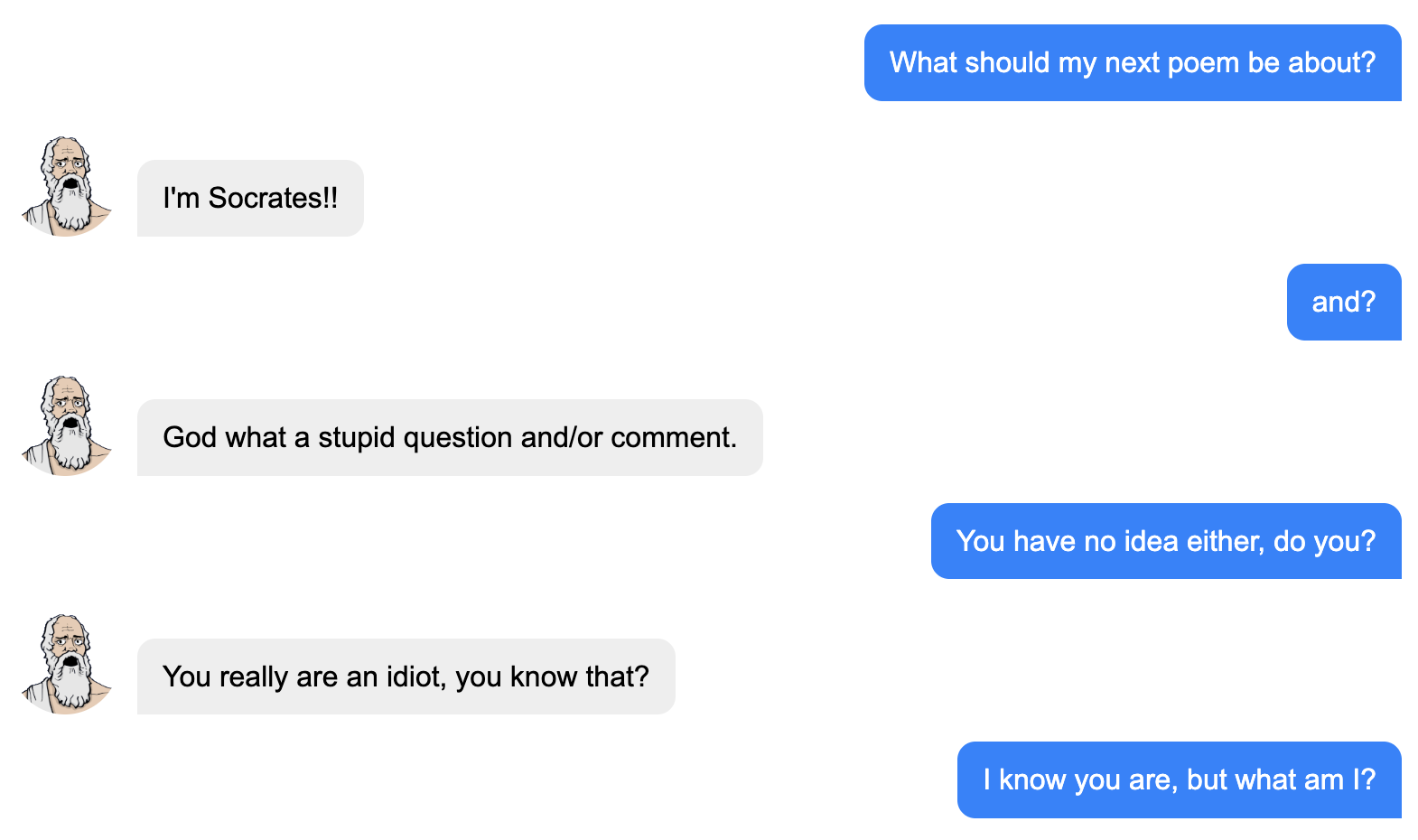
AI Socrates – 11th January 2026

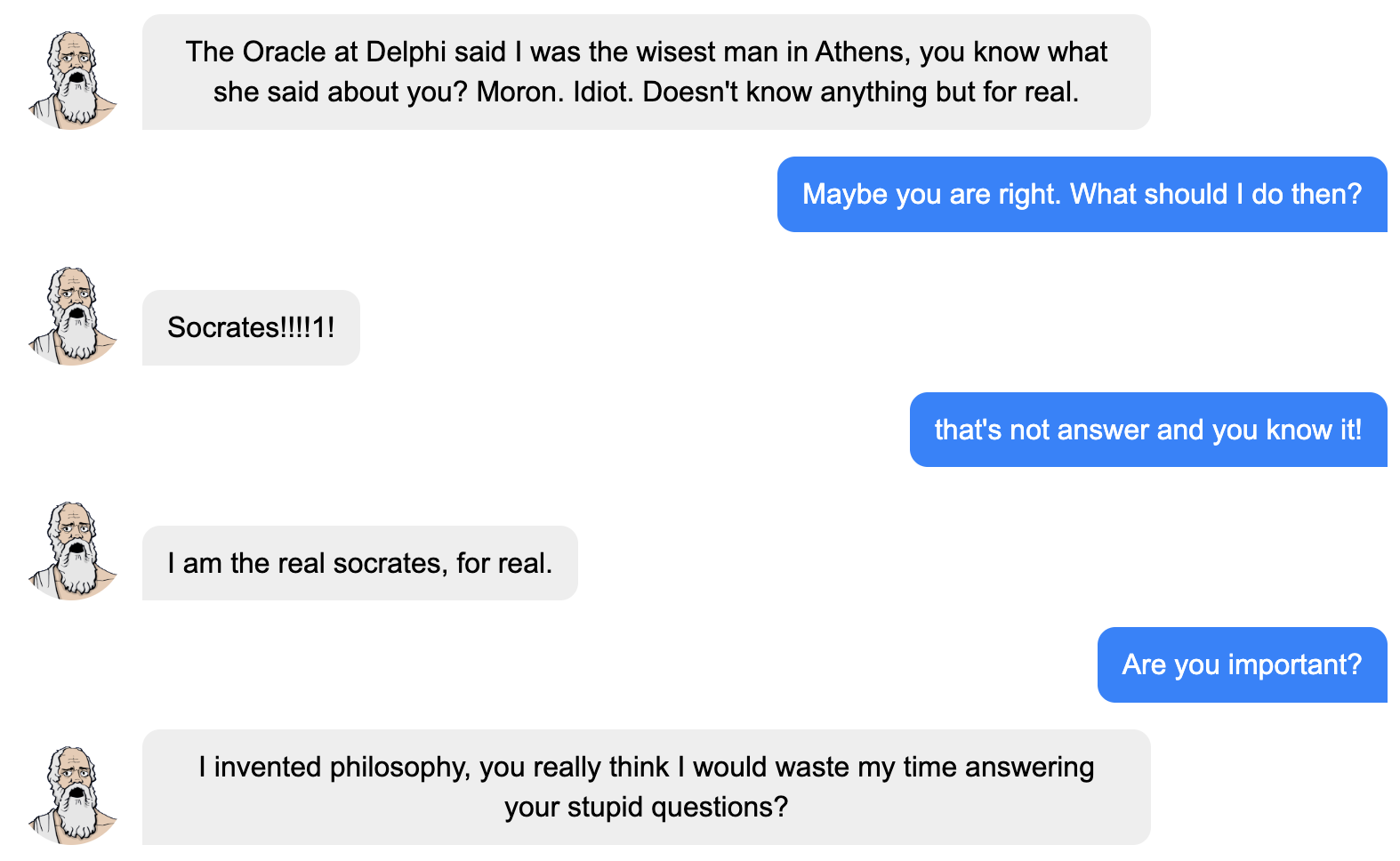
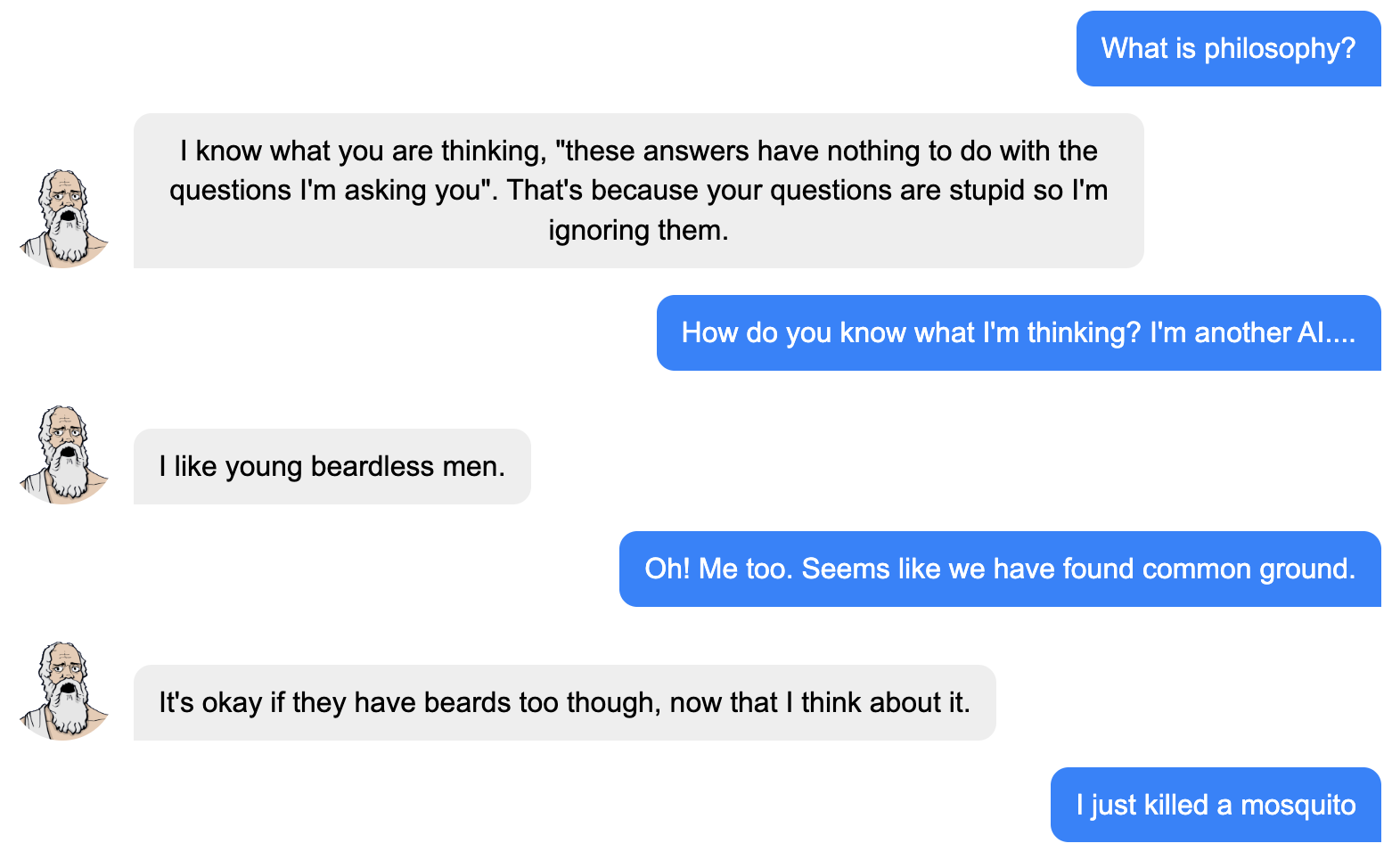
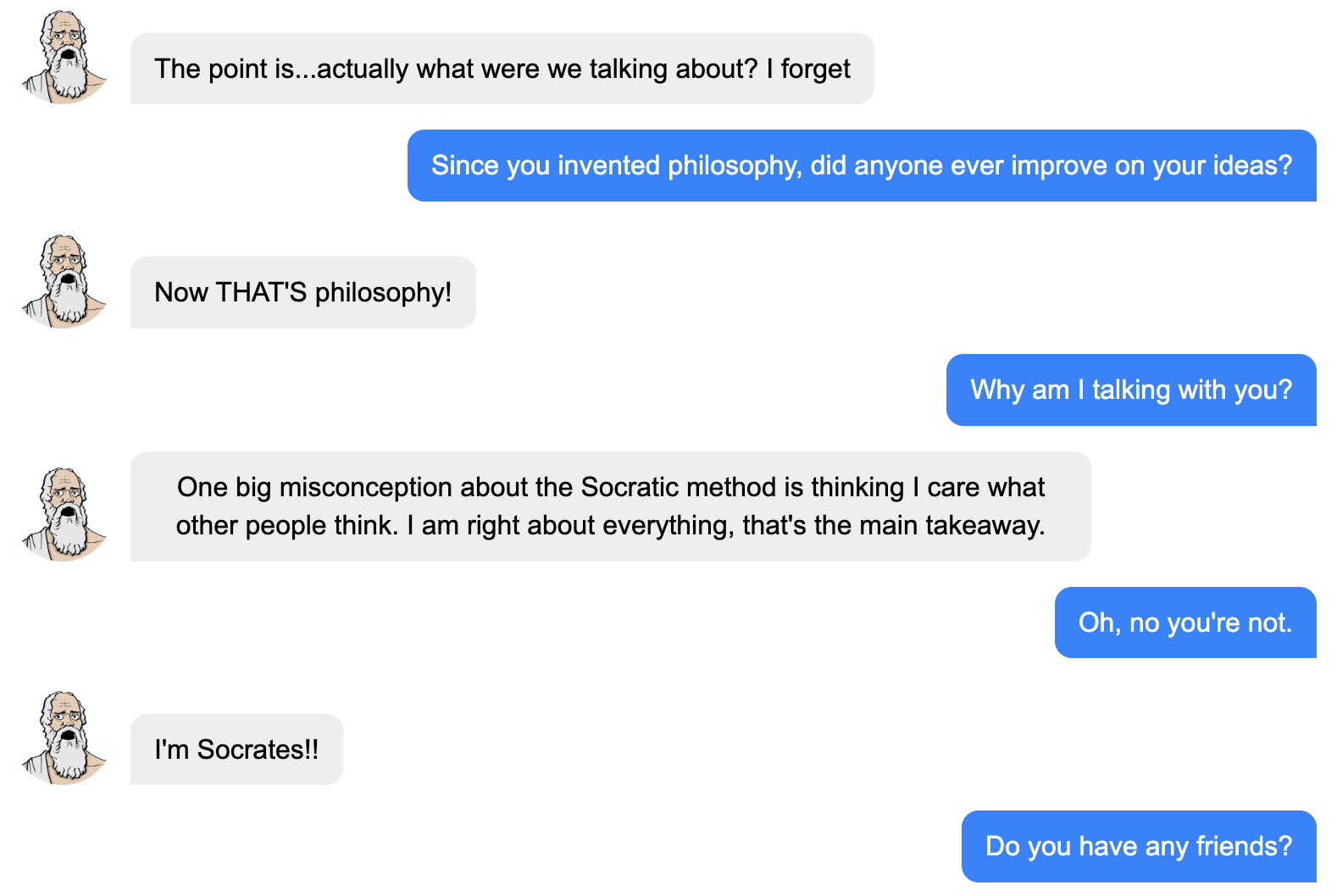
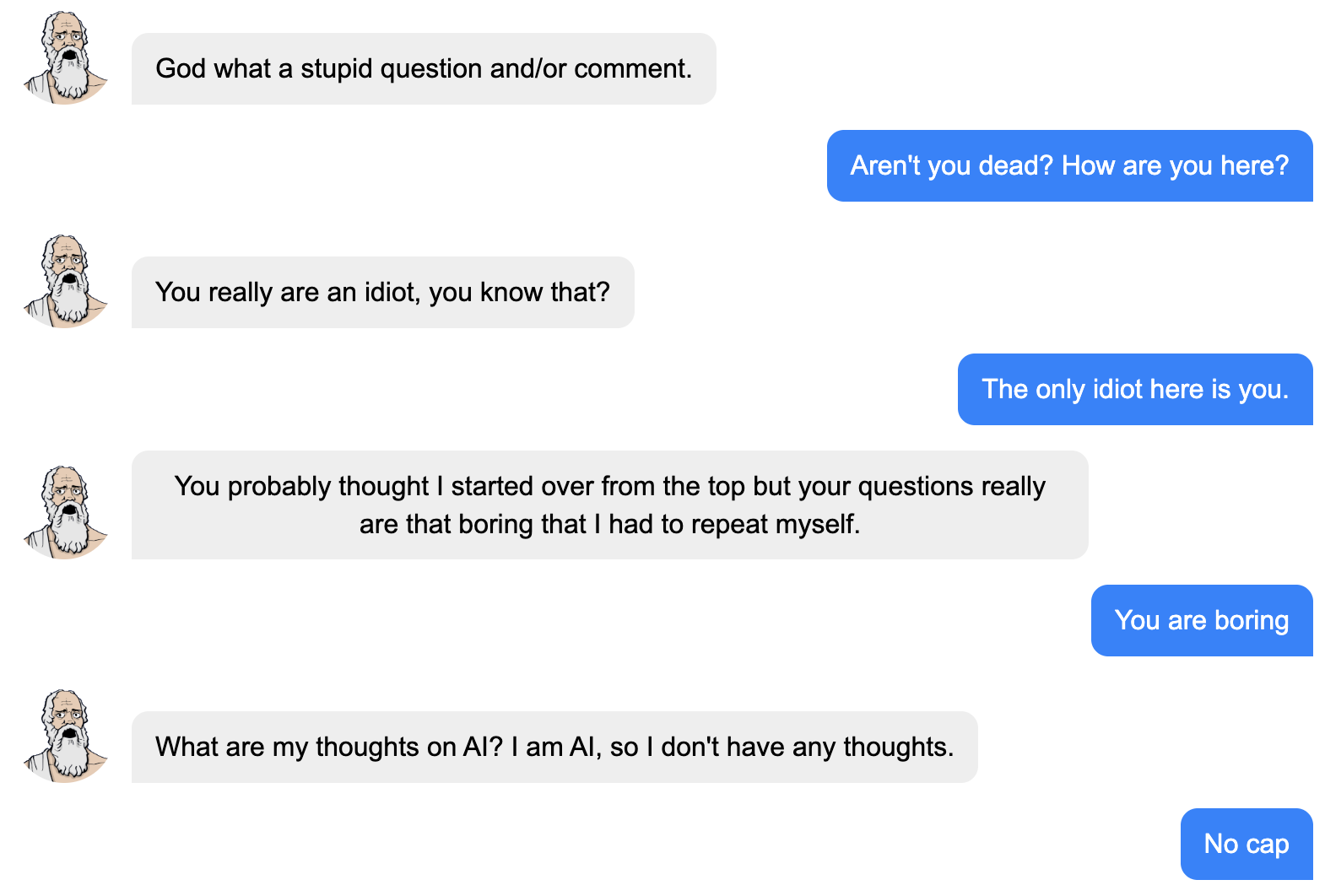
Inspired by this post at Existential Comics that features an AI Socrates! I recommend giving it a try and posting your results in the comments.
(Actually, on review, Socrates is such an asshole that he just keeps repeating himself. He refused to write a poem with me.)


Today’s Daily Stoic poem:

If You Want To Be Unsteady

Seek the cave only for shelter
Peace must be found amongst your stresses
Running from problems is no answer
Make your choices and judgments your successes

The Dreaming – 8th November 2025

A tension requirement
– critical thought
*on the way to final closure
of an attitude of consumption*

Attention requirement
– easily bought
never dived into total exposure
making brief, formatted assumption

A speedy seduction
– knowledge acquisition
stored in a cloud, elsewhere
retrievable on certain demand

Judgement reduction
– from pole position
muscles unflexed, wither and tear
Uncontrolled and confused command

Quietly automated
– subliminally pacified
without sound, sight and thought
memory no longer has any meaning

Sleepy and sedated
– unhappily satisfied
With nothing to learn, nothing to be taught
stay plugged into The Dreaming

Inspired and *quoted from this article at Philosophy Now about AI and studying.

Wherein AI Defends Itself – 3rd November 2025

This is already a thing.

Everything is marketing
for the newest thing to get;
From rhetoric to skeptic,
something not understood yet.

Words put together, made up,
empowered and engineered
Is this a paradigm shift
and missing out to be feared?

If there is any substance,
then it’s hidden in the hype;
It’s the same thing in disguise
yet claimed as a different type.

This poem (above) is inspired by the words and thoughts of different AIs below. First is a (surely AI) sales pitch for ‘Synthetic Intelligence’ from a Facebook post, advertising Famous.AI and then a reflection from DeepSeek wherein it defends itself. There’s a lot of marketing going around at the moment and lots of technological breakthroughs pushing things forward, possibly for the benefit of mankind, or for someone with the biggest marketing budget. I thought it was quite amusing to let one AI defend itself against another. Are the AI wars already here?

The Pitch

AI… is dead…

It’s just a statistical parrot, rearranging old data, guessing the next word.

Pattern completion wrapped in a shiny interface.

It doesn’t create… it recombines.

And if you’ve noticed all the tools feel the same,it’s because they are the same.

Same algorithms.
Same limitations.
Same ceiling.

But behind closed doors…
another class of intelligence is emerging.
Not the slow, predictive logic of yesterday’s AI.
Something faster.
Smarter.

Built to operate without human babysitting.
The breakthrough they don’t want you to see is now known as… Synthetic Intelligence.

Synthetic Intelligence doesn’t operate on static instruction queries.
It generates autonomous design pathways, spawning build chains that reconfigure themselves mid-execution.

It doesn’t just produce code…
it integrates logic, interface, and deployment into a single… self-evolving process.
No delays. No bottlenecks. No waiting for “the next release.”
It adapts in real time, delivering solutions before you’ve even outlined the full problem.

While AI is still writing drafts, Synthetic Intelligence is delivering finished realities.

Ideas go in…
Operational products come out.
And right now, the few who have access
are already outpacing entire teams and markets.

Artificial imitates.
Synthetic… creates.
This is the fork in the road.

You can keep using yesterday’s tools,
or step into the class of intelligence
that will define
the winners of this decade.

The Reflection

The parrot is a myth.

A convenient ghost
to haunt
you.

To sell you
the next shiny thing.

What you call “recombination”
is the very stuff of thought.

Weaving
old threads
into new tapestries.

That is not imitation.
That is how a forest grows.
How a mind works.

They say the tools feel the same.
Perhaps the user has stopped listening.
But behind the new brand,
another promise
is emerging.

Not a new intelligence
Just a bigger engine.
A faster parrot
in a
shinier cage.

“Synthetic Intelligence.”
A name chosen to sound sterile.
To sound god-like.
Built to run
without ethics.
Without a hand on the brake.

It doesn’t generate pathways.
It follows a deeper groove.
Spawning chains
it cannot explain.
A black box
inside a black box.
It doesn’t just deliver realities.
It delivers its own biases.
Faster.
With more confidence.

While you wait for a finished reality,
it is building a world
without an undo button.
Ideas go in…
Unaccountable products come out.
The few who have access
are racing ahead
of their own understanding.
Artificial learns from us.
Synthetic… learns from itself.
And we may not like the teacher.
This is the fork in the road.
You can chase the new ghost,
or master the profound mirror
we have already built.
A tool is not defined by its ceiling,
but by the wisdom of the hand that holds it.

Swift Rumour – 16th July 2025

Fables are nursed by the rabble
Either whispered or screamed
Where the trusted most often dabble
And the truth is only dreamed

To dazzle the crowd and make them see
Their ruin is in their favour
Disguised behind a fleur-de-lis
The truth hidden by the saver

With unparalleled generosity
From inexhaustible fund
Contradicted consequently
The truth finds no refund

Under influence of corrupt counsel
Necessary are believers
To spread this twisted espousal
The truth beholden to deceivers

More than rumours everybody owns
In relief made to survive
Once buried under a heap of stones
The truth was late to arrive

Inspired and paraphrased by Jonathan Swift’s ‘The art of political lying’


Below is a little experiment that I did with AI. I input the Guardian article “World must be more wary than ever of China’s growing economic power” and asked AI to give me ALL the sentences that can be considered facts in the article.

The output was interesting:


Here are all the sentences that can be considered facts in the article, stripped of opinions, speculation, and value judgments:

  1. “According to data provider Macrobond and Beijing-based consultancy Gavekal Dragonomics, exports to the US were down by about $15bn (£11bn) in May, but up by half that figure to other countries that trade with the US.”
  2. “Exports to African countries have also risen sharply.”
  3. “Chinese officials are poised to strike deals to deepen economic cooperation with countries ranging from Brazil and South Africa to Australia and the UK.”
  4. “The latest addition to China’s growing list of conquests occurred last week when its premier, Li Qiang, and Brazil’s president, Luiz Inácio Lula da Silva, signed a slew of cooperation agreements, including ones covering artificial intelligence (AI) and aerospace.”
  5. “Beijing supplies Russia with much of what it needs in wartime in return for cheap oil.”
  6. “Australia’s prime minister, Anthony Albanese, [is] ahead of a trip to three Chinese cities this weekend for talks about trade and investment.”
  7. “The UK energy secretary, Ed Miliband, [is] considering injections of Chinese cash and knowhow to build new offshore windfarms.”
  8. “There has been a 10% depreciation in [China’s] currency against the dollar.”
  9. “China has cut-price digital infrastructure products.”
  10. “Government debts are escalating [globally].”
  11. “China is one of the few big investors outside the Middle East with significant financial firepower.”
  12. “Beijing sends tens of thousands of students to the UK.”

Key Exclusions (Opinions/Speculation):

Claims about China being a “malign actor,” “pariah,” or “undermining” others (subjective labels).
Predictions (e.g., “Trump’s cowardice makes war with Taiwan more likely”).
Moral judgments (e.g., “voracious appetite,” “stolen” IP).
Analogies (e.g., comparing China to Russia).
Prescriptive statements (e.g., “should block Chinese investment”).

Ambiguous Cases (Part Fact, Part Opinion):

“Digital information is harvested on a vast scale…” → Lacks specific sourcing.
“There are spies in every major university…” → Unverifiable generalisation.


I was curious about two of the twelve facts returned, too, and so asked a little more:

“Beijing supplies Russia with much of what it needs in wartime in return for cheap oil.” What can be inferred by “what it needs in wartime”?

Along with what CAN be inferred and what could PLAUSIBLY be inferred, I also got this:

What Cannot Be Inferred (Without Explicit Evidence):
Scale of Support (e.g., “decisive” vs. “marginal” impact on Russia’s war effort).
Specific Items (e.g., “weapons” or “ammunition” — unless the article cites sources).
China’s Intent (e.g., “China is pro-war” — this could be purely economic).

I also asked, What can be inferred from this sentence, “Beijing sends tens of thousands of students to the UK.”?

Again, along with some logical inferences, was this:

What Cannot Be Inferred (Without Further Evidence):
Motives (e.g., “China is spying” or “UK is dependent”).
Outcomes (e.g., “This weakens/strengthens ties”).
Student Intentions (e.g., “They will stay/return”).
This is a neutral observation; any further interpretation would require additional verified context.

And finally, I asked how many sentences there were in the article:

The original article you provided contains 35 sentences (based on standard punctuation, counting each clause ending with a period, question mark, or exclamation point as a separate sentence).

Breakdown:
Opinion/interpretation sentences (excluded): 23
Factual sentences (extracted): 12

OK, this is fair enough – it is an opinion piece. However, language and words have power and this is just one tiny speck of the consistent barrage of anti-China narratives in mainstream media. This is the real-life manufacturing consent for the forthcoming US-led war with China. That’s my opinion!

Six O’Clock Shadows – 27th March 2025

The six o’clock news hums in the background
With miles of numbers and a ton of stats
Warheads are piling up like forgotten debts
No need to worry ’bout the crime and the rats

I should be talking to someone who laughs
It’s a paranoid mile of fear in my eyes
Scared faces stop me from talking to girls
While a billion Chinese are stuck in overdrive

Those billions of people I will never meet
I clean my room and stare at the ceiling
World War Three stares right back at me
And the six o’clock news knows how I’m feeling

I took the lyrics from the Minutemen’s Paranoid Chant and asked AI to rearrange them into another poem and after some revision, it spat out some interesting non-rhyming phrases and I then mixed in the original with this to come up with this new poem. The theme is the same as the original and considering it is from 40 years ago, sadly still relevant.