Inspired by the parable of the Useless Tree and shared with Poetic Bloomings #571 – Nothing But Trees:
Carpenter Shi was travelling through the countryside with his young apprentice when they came upon a village shrine built around an enormous oak tree. The tree was ancient beyond measure, its trunk so vast that a thousand men holding hands couldn’t encircle it. Its branches spread like a green cathedral, offering shade to the entire village square.
The apprentice stood transfixed. “Master!” he called excitedly. “In all my travels, I’ve never seen timber so magnificent! Why won’t you even look at it?”
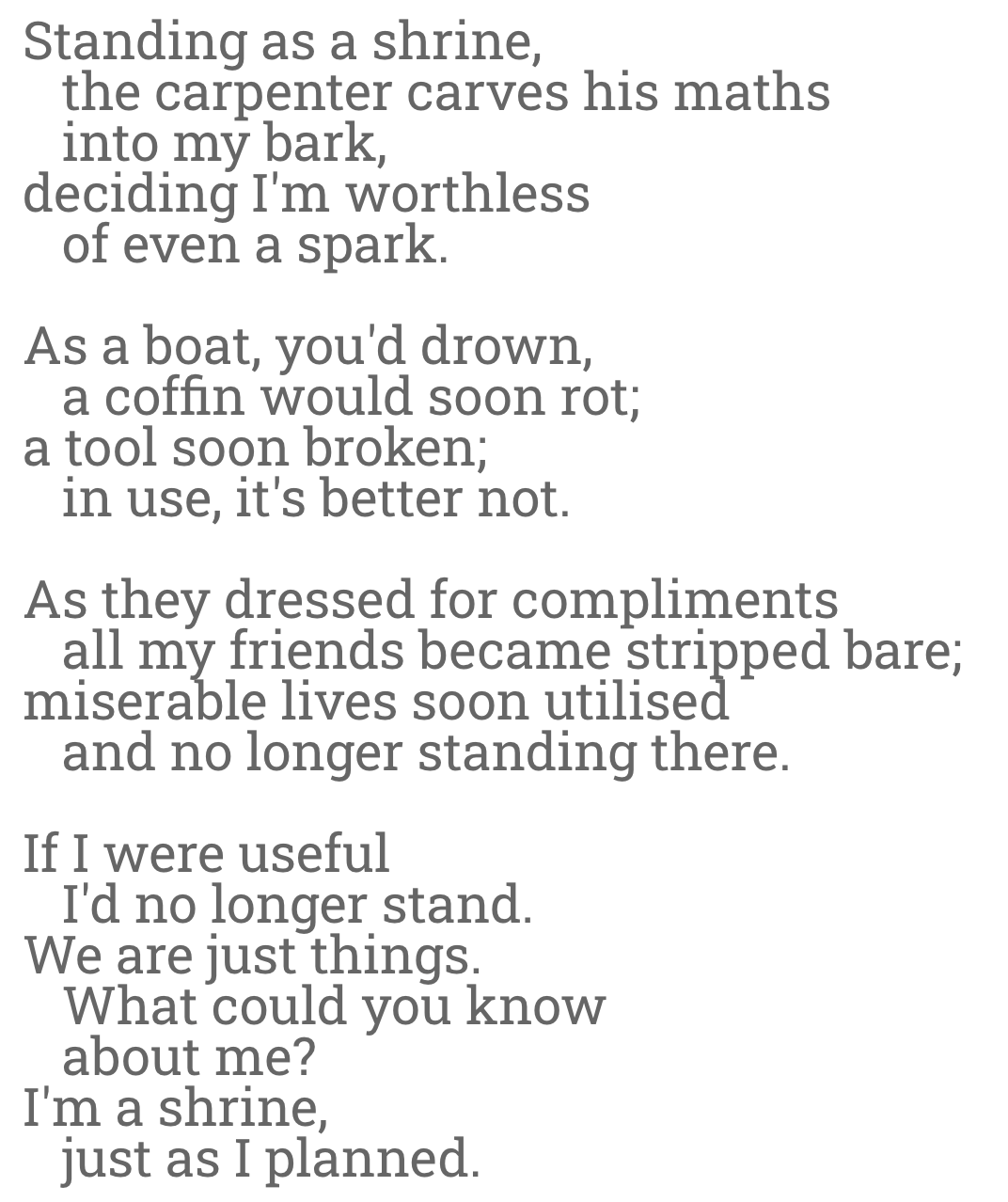
Carpenter Shi barely glanced up from his path. “Worthless wood,” he muttered dismissively. “Make boats from it and they’ll sink. Make coffins and they’ll rot before the bodies do. Make tools and they’ll break in your hands. Make houses and they’ll be eaten by worms. It’s completely useless—that’s the only reason it’s lived so long.”
The carpenter continued on his way, but that night the great tree appeared to him in a dream.
“What are you comparing me to?” asked the tree. “Fine trees like cherry and pear? Those trees that bear fruit are attacked the moment they ripen. Their branches are broken, their bark is stripped. Their very usefulness makes their lives miserable, cutting short their natural span. This happens to all things.
“I’ve been working for ages to become perfectly useless. I nearly died several times in the attempt, but I’ve finally succeeded. My uselessness is now my greatest usefulness. If I had been useful, do you think I could have grown this large?
“Besides, you and I are both just things in this world. How can one thing judge another? You’re a dying man who understands nothing—what could you know about a useless tree?”
When Carpenter Shi awoke, he told his apprentice about the dream. The young man was confused: “If the tree wants to be useless, why does it serve as a shrine?”
The master smiled. “Quiet! It’s simply taking shelter there. Those who don’t understand it might harm it otherwise. If it weren’t a shrine tree, wouldn’t it be in danger of being cut down? Its way of preserving itself is different from ordinary trees, so using conventional standards to judge it will lead us far astray.”
On the surface, this story seems to be about different definitions of value—the carpenter sees lumber, the tree sees survival. But dig deeper and you discover something revolutionary: the tree has found freedom through strategic uselessness.
What if our quirks, our imperfections, our refusal to fit standard molds aren’t bugs in our programming but features? What if the very things that make us “unemployable” in one context make us invaluable in another?




 1994ever