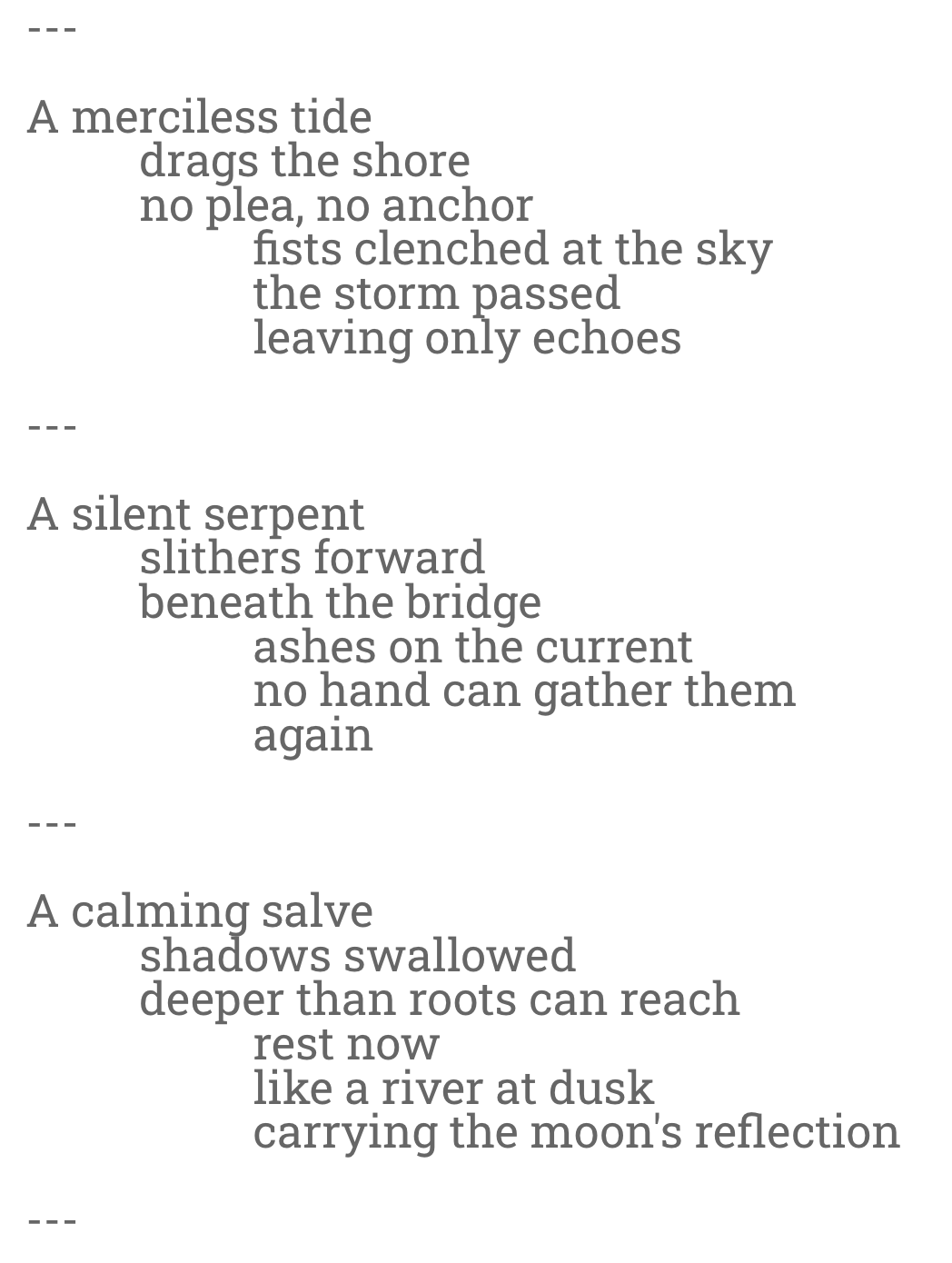
Form: Bloated Haiku (10-15-10 syllables) Rules: Subject must be cultural and philosophical
I totally made this up. Am I a creator?
Oh, this poem was inspired (and paraphrased) by this post on Substack by Jim Richardson. The poem is not particularly connected to the content as the paraphrasing is drawn from the first paragraph. I just liked these words and thoughts together.
The charmer has good game, a new room every night’ A silence can explain when the words don’t feel right;
Maybe old and spicy, a smile that seems sincere; Pearly blues so icy, direction sharp and clear;
The holder of the cup, a life that overflows; Forgets the runner-up, the one that no one knows;
This charismatic man was always bound to be; Winning since life began, is definitely not me.
Written for the GloPoWriMo Day 7 prompt: write a self-portrait poem, in which you explain why you are not a particular piece of art (a symphony, a figurine, a ballet, a sonnet), use at least one outlandish comparison, and a strange (and maybe not actually real) fact.
Here are all the sentences that can be considered facts in the article, stripped of opinions, speculation, and value judgments:
“According to data provider Macrobond and Beijing-based consultancy Gavekal Dragonomics, exports to the US were down by about $15bn (£11bn) in May, but up by half that figure to other countries that trade with the US.”
“Exports to African countries have also risen sharply.”
“Chinese officials are poised to strike deals to deepen economic cooperation with countries ranging from Brazil and South Africa to Australia and the UK.”
“The latest addition to China’s growing list of conquests occurred last week when its premier, Li Qiang, and Brazil’s president, Luiz Inácio Lula da Silva, signed a slew of cooperation agreements, including ones covering artificial intelligence (AI) and aerospace.”
“Beijing supplies Russia with much of what it needs in wartime in return for cheap oil.”
“Australia’s prime minister, Anthony Albanese, [is] ahead of a trip to three Chinese cities this weekend for talks about trade and investment.”
“The UK energy secretary, Ed Miliband, [is] considering injections of Chinese cash and knowhow to build new offshore windfarms.”
“There has been a 10% depreciation in [China’s] currency against the dollar.”
“China has cut-price digital infrastructure products.”
“Government debts are escalating [globally].”
“China is one of the few big investors outside the Middle East with significant financial firepower.”
“Beijing sends tens of thousands of students to the UK.”
Key Exclusions (Opinions/Speculation):
Claims about China being a “malign actor,” “pariah,” or “undermining” others (subjective labels). Predictions (e.g., “Trump’s cowardice makes war with Taiwan more likely”). Moral judgments (e.g., “voracious appetite,” “stolen” IP). Analogies (e.g., comparing China to Russia). Prescriptive statements (e.g., “should block Chinese investment”).
Ambiguous Cases (Part Fact, Part Opinion):
“Digital information is harvested on a vast scale…” → Lacks specific sourcing. “There are spies in every major university…” → Unverifiable generalisation.
I was curious about two of the twelve facts returned, too, and so asked a little more:
“Beijing supplies Russia with much of what it needs in wartime in return for cheap oil.” What can be inferred by “what it needs in wartime”?
Along with what CAN be inferred and what could PLAUSIBLY be inferred, I also got this:
What Cannot Be Inferred (Without Explicit Evidence): Scale of Support (e.g., “decisive” vs. “marginal” impact on Russia’s war effort). Specific Items (e.g., “weapons” or “ammunition” — unless the article cites sources). China’s Intent (e.g., “China is pro-war” — this could be purely economic).
I also asked, What can be inferred from this sentence, “Beijing sends tens of thousands of students to the UK.”?
Again, along with some logical inferences, was this:
What Cannot Be Inferred (Without Further Evidence): Motives (e.g., “China is spying” or “UK is dependent”). Outcomes (e.g., “This weakens/strengthens ties”). Student Intentions (e.g., “They will stay/return”). This is a neutral observation; any further interpretation would require additional verified context.
And finally, I asked how many sentences there were in the article:
The original article you provided contains 35 sentences (based on standard punctuation, counting each clause ending with a period, question mark, or exclamation point as a separate sentence).
OK, this is fair enough – it is an opinion piece. However, language and words have power and this is just one tiny speck of the consistent barrage of anti-China narratives in mainstream media. This is the real-life manufacturing consent for the forthcoming US-led war with China. That’s my opinion!
A list poem that starts this way Because another form comes into play Can be seen as difficult, for sure Do read on, as I will explore Every nuance of this list I write Forming here in black and white Going forward, we must begin Here listing so many things akin I’ll start, I will, I promise, soon Just give me a minute to attune Keen, I am to make this perfect Like a real word architect Maybe I need to start the list here? No, not just yet, I fear Only I, the holder of the pen Provoking the inspiration when Questions arise from further in Ready to get deeper under the skin Shall we start? I think we’re ready To see the first line, strong and steady Underneath, the list will form Variations of this long brainstorm Where’s the list? I hear you ask Xenial towards this unusual task You’re wondering if I can succeed Zoned out, I forgot to proceed And so it goes around again….
I recently listened to the No Dogs In Space podcast’s four-part series on the band Joy Division and though this poem is shared for the W3 prompt of ‘scape’, I couldn’t get away from the word ‘escape’. The first line popped into my head (in reference to lead singer Ian Curtis’ suicide) and then Joy Division song titles flowed forth to fill in much of the rest of the poem. The title is taken from the second and final Joy Division album of the same name and can be understood in either way, to be near something or the end of something.